Introduction
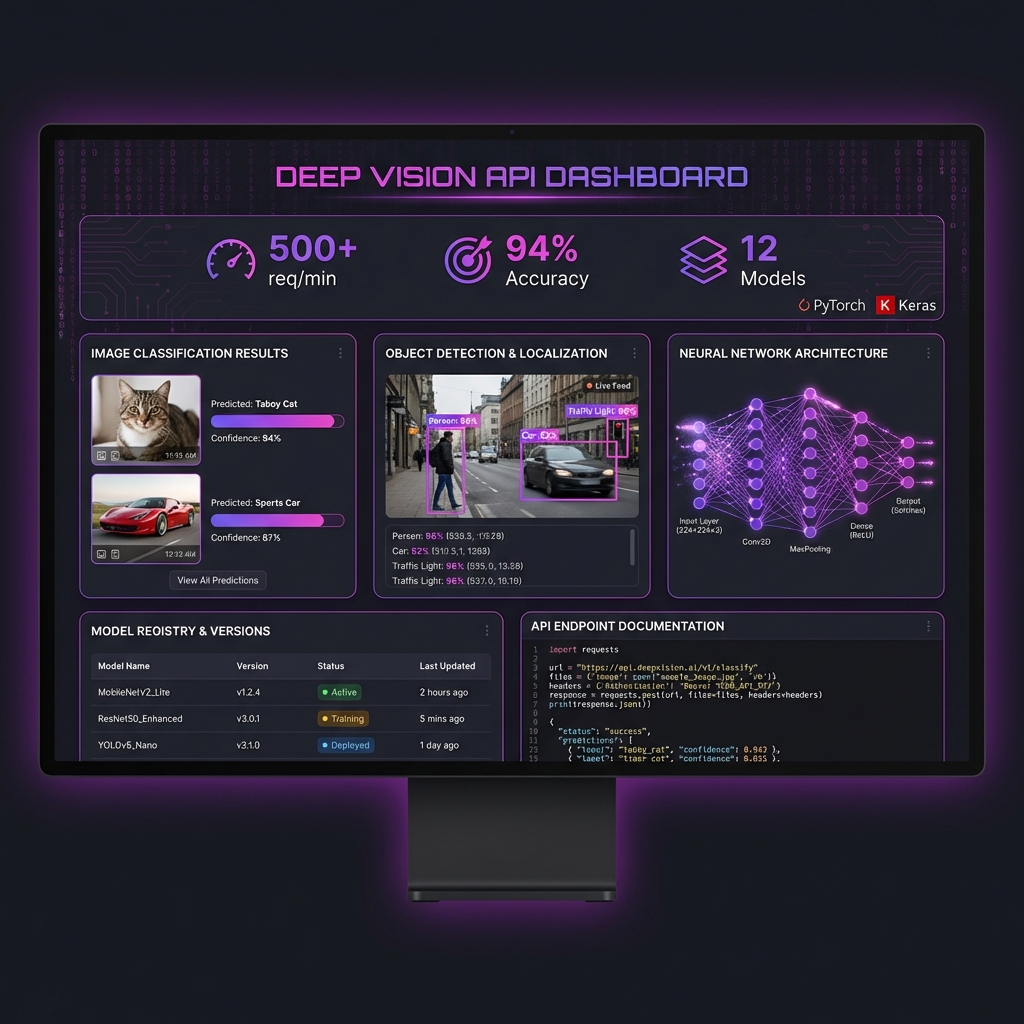
The Deep Learning Vision API brings production-grade computer vision capabilities to businesses without requiring ML expertise. This project implements state-of-the-art image classification and object detection models, optimized for inference speed and deployed as a scalable REST API.
The Challenge
Machine learning models often remain in Jupyter notebooks, never reaching production. The gap between training a model and deploying it reliably at scale involves complex challenges: model optimization, API design, GPU resource management, versioning, and monitoring. The goal was to bridge this gap with a production-ready inference platform.
The Solution
We built custom CNN architectures using PyTorch for image classification and integrated YOLO for object detection. Models are optimized with TensorRT and served via FastAPI with automatic batching. The platform includes MLflow for experiment tracking and model registry.
Technical Deep Dive
Trained custom ResNet-based classifier achieving 94% accuracy on 50-class domain-specific dataset
Implemented YOLO-v8 fine-tuning for custom object detection with transfer learning
Optimized inference with TensorRT achieving 5x speedup over vanilla PyTorch
Built automatic request batching maximizing GPU utilization during high load
Deployed canary releases and A/B testing infrastructure for model comparison
Key Features
Image Classification
Multi-class prediction with confidence scores and top-k results
Object Detection
Real-time bounding box detection with class labels and scores
Model Registry
Version control for models with rollback and comparison capabilities
Auto-Batching
Intelligent request batching for optimal GPU utilization
Performance Monitoring
Latency tracking, accuracy drift detection, and usage analytics
Results & Impact
- ✓Serving 500+ inference requests per minute with sub-200ms latency
- ✓Achieved 94% accuracy on image classification task
- ✓Reduced model deployment time from weeks to hours
- ✓Enabled production ML for teams without infrastructure expertise
Lessons Learned
"Model accuracy means nothing if inference is too slow for production use"
"Monitoring model drift is as important as initial accuracy metrics"
"API design should hide ML complexity from consumers"
Conclusion
Deploying ML models to production requires treating the entire pipeline as an engineering problem. By focusing on reliability, speed, and developer experience, we've made advanced computer vision accessible to any application.
Interested in a Similar Project?
Let's discuss how I can help bring your ideas to life.
Get in Touch